


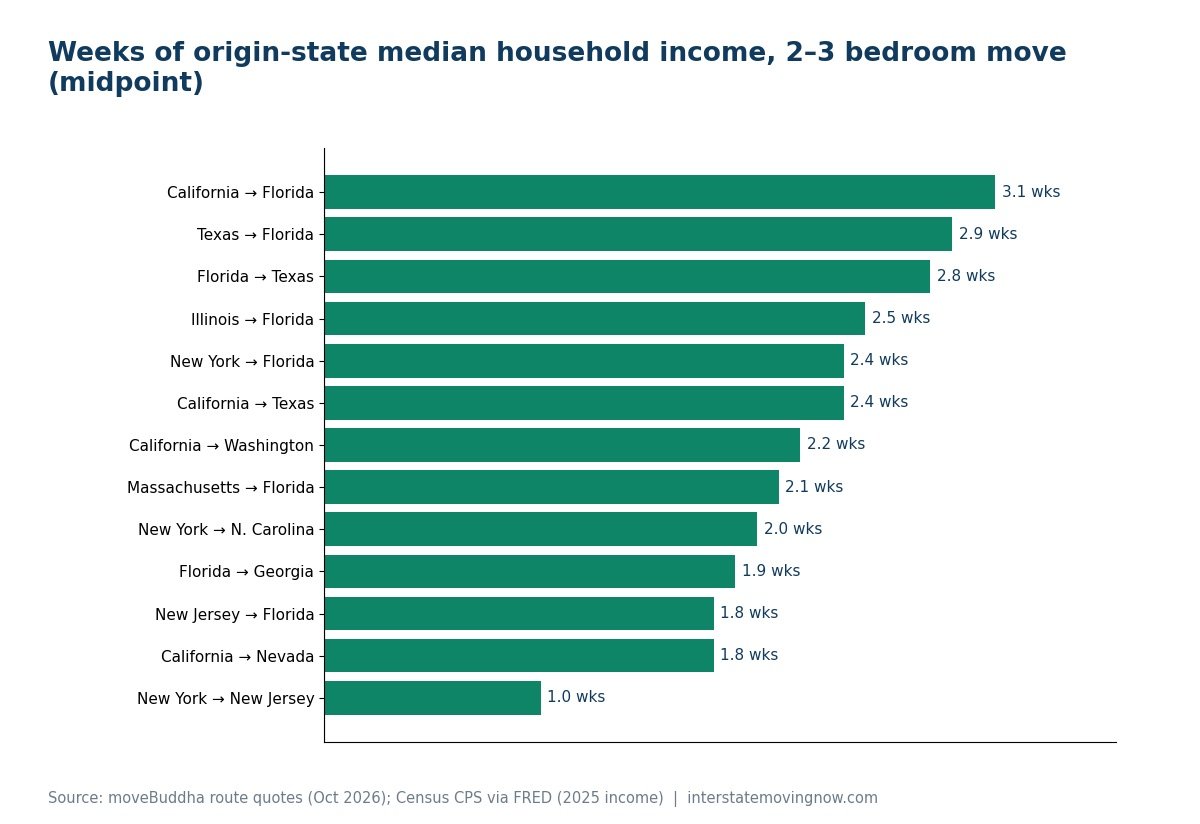
Quick answer: A full-service interstate move of a two- to three-bedroom home costs the typical household about two to three weeks of income in 2026. California to Florida is the most expensive of the 15 popular routes we measured, at 3.1 weeks of California’s median household income at the midpoint price and up to 4.2 weeks at the top of the range.
Moving quotes are hard to judge in dollars alone, because $5,000 means something different in Massachusetts than in Florida. So we measured each move against the paycheck of the state people are leaving. We combined moveBuddha’s 2026 route prices, based on real quotes, with each origin state’s 2025 median household income from the U.S. Census Bureau, published through the Federal Reserve Bank of St. Louis (FRED).
Last updated: October 23, 2026
Key findings
- 2 to 3 weeks of income is what a typical two- to three-bedroom full-service interstate move costs on most of the 15 routes, at the midpoint price.
- California to Florida is the costliest: 3.1 weeks of income at the midpoint ($6,020) and 4.2 weeks at the high end ($8,110).
- Florida movers pay relatively more: Florida’s lower median income ($77,920) makes Florida to Texas cost 2.8 weeks, more than New York to Florida (2.4 weeks).
- High-income origins move cheapest relative to pay: New Jersey to Florida takes 1.8 weeks and Massachusetts to Florida 2.1 weeks.
- The top of the quote range adds about a week: on every long route, the high quote costs roughly one more week of income than the midpoint.
How many weeks of income does an interstate move cost?
The table ranks routes by weeks of the origin state’s median household income needed to pay the midpoint of the full-service price range for a two- to three-bedroom home.
| Route | 2–3 bedroom full-service range | Origin median household income (2025) | Weeks at midpoint | Weeks at high end |
|---|---|---|---|---|
| California → Florida | $3,930 – $8,110 | $100,800 | 3.1 | 4.2 |
| Texas → Florida | $2,720 – $6,660 | $85,060 | 2.9 | 4.1 |
| Florida → Texas | $2,400 – $5,870 | $77,920 | 2.8 | 3.9 |
| Illinois → Florida | $2,700 – $6,350 | $93,270 | 2.5 | 3.5 |
| New York → Florida | $2,340 – $5,740 | $86,900 | 2.4 | 3.4 |
| California → Texas | $2,790 – $6,530 | $100,800 | 2.4 | 3.4 |
| Illinois → Texas | $2,520 – $5,670 | $93,270 | 2.3 | 3.2 |
| California → Washington | $2,530 – $6,100 | $100,800 | 2.2 | 3.1 |
| California → Arizona | $2,330 – $5,800 | $100,800 | 2.1 | 3.0 |
| Massachusetts → Florida | $2,800 – $6,590 | $118,500 | 2.1 | 2.9 |
| New York → North Carolina | $1,860 – $4,660 | $86,900 | 2.0 | 2.8 |
| Florida → Georgia | $1,460 – $4,330 | $77,920 | 1.9 | 2.9 |
| New Jersey → Florida | $2,430 – $5,480 | $111,400 | 1.8 | 2.6 |
| California → Nevada | $1,790 – $5,100 | $100,800 | 1.8 | 2.6 |
| New York → New Jersey | $860 – $2,550 | $86,900 | 1.0 | 1.5 |
Price ranges come from moveBuddha’s route pages, each based on several hundred to more than a thousand recent quotes: for example California to Florida (847 quotes), New York to Florida (1,221), California to Texas (942) and Massachusetts to Florida (1,157).
Why do Florida and Texas movers pay more relative to income?
Because the median household in the origin state earns less, not because the move costs more. Florida’s 2025 median household income was $77,920 and Texas’s $85,060, according to Census data on FRED for Florida and Texas, both below the U.S. median of $87,460. A Florida-to-Texas move at a $4,135 midpoint therefore costs 2.8 weeks, while a New Jersey-to-Florida move at a similar $3,955 midpoint costs only 1.8 weeks of New Jersey’s $111,400 median.
The two Sun Belt states also trade a lot of movers with each other over long distances. Quotes on the Florida-to-Texas route average 1,366 miles, according to moveBuddha, so it prices close to a cross-country move. Our Texas to Florida and Florida to Texas reports break those routes down by home size.
Our analysis: what does distance do to the paycheck cost?
We divided each route’s midpoint price by its average quoted distance from moveBuddha. Short routes cost far more per mile, but far less in weeks of pay. New York to New Jersey (71 miles) costs about one week of income. Routes of 400 to 1,000 miles, such as California to Nevada or California to Washington, cost about two weeks. Cross-country routes over 1,100 miles land between 2.4 and 3.1 weeks. Doubling the distance adds well under a week of income, because loading, labor and packing, not miles, make up most of the bill. That is why cutting inventory saves more than choosing a closer destination.
| Route | Avg quoted distance | Midpoint price | Price per mile | Weeks of income |
|---|---|---|---|---|
| New York → New Jersey | 71 mi | $1,705 | $24.01 | 1.0 |
| Florida → Georgia | 371 mi | $2,895 | $7.80 | 1.9 |
| California → Nevada | 397 mi | $3,445 | $8.68 | 1.8 |
| New York → North Carolina | 511 mi | $3,260 | $6.38 | 2.0 |
| California → Arizona | 736 mi | $4,065 | $5.52 | 2.1 |
| California → Washington | 955 mi | $4,315 | $4.52 | 2.2 |
| New York → Florida | 1,150 mi | $4,040 | $3.51 | 2.4 |
| Florida → Texas | 1,366 mi | $4,135 | $3.03 | 2.8 |
| California → Texas | 1,407 mi | $4,660 | $3.31 | 2.4 |
| California → Florida | 2,699 mi | $6,020 | $2.23 | 3.1 |
The quote range matters as much as the route. On California to Florida, the gap between the low and high quote ($4,180) is worth 2.2 weeks of income. Getting three binding or binding not-to-exceed estimates, as our guide to moving estimates explains, is the cheapest week of pay you will ever earn.
How can you cut the cost of a move in weeks of pay?
- Ship less. Weight drives price; sell or donate furniture that costs more to move than to replace.
- Move off-peak. Late fall through early spring is usually cheaper; see our seasonal moving cost index.
- Mix methods. A container or rental truck plus hired loading labor costs a fraction of full service on many routes; compare in our DIY vs. hiring movers report.
- Ask about relocation help. Employer packages are taxable for civilians, but still worth negotiating; see whether moving expenses are tax deductible.
Methodology and sources
Moving costs are moveBuddha’s full-service price ranges for two- to three-bedroom homes on each route, based on quotes from the 90 days before October 23, 2026; the midpoint is the average of the low and high figures. moveBuddha updates these ranges continuously, so our individual route reports, compiled earlier in 2026, may show slightly different figures for the same route. Income is the 2025 median household income for the origin state from the U.S. Census Bureau’s Current Population Survey, published as FRED series MEHOINUS[state]A646N (current dollars), for example California, New York and Illinois. Weeks of income = midpoint price ÷ (median household income ÷ 52). Gross income is used, so the share of take-home pay is higher. State-level CPS income estimates have wide sampling error and can jump from year to year (Illinois rose from $83,090 to $93,270), so treat small differences between routes as noise.
FAQ
How much of my income should I budget for an interstate move?
For a two- to three-bedroom full-service move, budget about two to three weeks of household income on most routes, and up to four weeks on cross-country routes like California to Florida if your quote lands at the top of the range.
What is the most expensive move relative to income?
Of the 15 routes we measured, California to Florida: a $6,020 midpoint is 3.1 weeks of California’s $100,800 median household income.
Is it cheaper to move from a high-income state?
Relative to pay, yes. Moving from New Jersey or Massachusetts to Florida costs about two weeks of those states’ median income, because incomes there are high and prices are similar to other long routes.
Where does the income data come from?
From the U.S. Census Bureau’s Current Population Survey, via the St. Louis Fed’s FRED database, for 2025.
Estimate your own move with our interstate moving cost calculator.








No Comments